Total Pageviews

Monday, July 11, 2016

On Silk, Scarves and Sustainability

Scarves are, without doubt, one of the most useful things to have with you when travelling. You can use them as a towel, a bedspread, knot them up to create a makeshift bag – you can even turn them into a dress or skirt if the occasion so calls for it.


Not all scarves are created equal, however. A scarf made from nylon may cause skin irritation over time, a scarf made from wool might feel scratchy and keep one too warm for certain climates. Although not the choice for budget backpackers, silk scarves are actually perfect for travel, as its high absorbency means greater comfort for those travelling in warmer climes. Silk also has a low rate of conductivity, which means that it’s better at keeping you warm when you’re travelling in chilly weather. Apart from breathability and comfort, silk also has a gorgeous lustrous sheen to it – thus having both form and function for the fashion conscious traveler. The last bonus point I’ll mention is – silk is apparently excellent at protecting one’s skin from hungry insects and mosquitos, as it is not pierced as easily as ordinary material used for clothing.

Silk however gets a bad rep from animal activists, who protest against the process of silk production, which involves boiling the cocoons woven by the silkworms. The silkworm releases certain enzymes to create a hole in the cocoon (so it can escape as a moth), however this cuts the single continuous thread produced by the worm into many short segments. The boiling is done to kill the worm inside in order to prevent it from releasing these enzymes.


Habotai silk, a soft lightweight silk originally produced in Japan, is produced otherwise. Habotai is made from the rescued strands of the broken cocoon and spun together to recreate a long single thread. In fact, this type of silk has a rather different texture, with small bumps along the thread showing where the broken strands have been rejoined. This kind of silk also takes dye easily, so as well as being sustainable, it is also very versatile. It was traditionally used for the lining of clothes because of its lightness and softness, with the word ‘habotai’ meaning ‘soft as down’ in Japanese.

So what will it be for your next trip? A long flowy shawl in cerulean blue, or a short silk scarf in Egyptian red?

Tuesday, July 29, 2014

How To Successfully Move Abroad (the lessons learned by someone who hasn't managed it so far)

I sit on the bed, gripping a mug tightly between my knuckles, my jaw partially open in shock as I stare at a hijab-ed lady, who gives me a quick hug and leaves my bedroom. She is (or was) my landlady; and she had given me three days notice to find a place and conned me out of 186 British pounds.

In an attempt to follow my dream of become an established travel journalist, I had applied for an internship with the award-winning travel publication Wanderlust (www.wanderlust.co.uk), and was actually accepted. So, less than a month after finishing my final university exams - and less than two weeks after handing in my final assignment - I set off to the UK to work in the office in Windsor. A whole lot of dragging my luggage about, two con artists, and a lot of money later - here I am in my third week of the internship, staying with some (absolutely lovely) people from work and looking for a place (again). Not the most pleasant experience ever, but I did learn some street-smarts - and I'm sharing with you what I've learned so far (so hopefully you'll avoid the mess that I went though).

1.) Trust people. But don't trust people.

When it sounds to good too be true, maybe it isn't. When I found a great place close to work for such a cheap price, I jumped head first for it - and straight into their trap. There are loads of kind, generous people out there, but then there's that occasional person that's just looking to take advantage of your situation. So always watch your luggage, keep your passport/cards in a safe place that's a bit unsual (so not your back pocket), and always ALWAYS ask for a receipt or some kind of proof when handing over money to someone. If an agreement was made on something, get it in black and white on paper - watch your own back.

2.) When looking for a place to rent, examine it with utmost scrutiny.

Wipe your finger along the top of shelves, remove part of the duvet on the bed to take a look at (and even try lying on) the mattress, ask about whether the shower does different temperatures and drains properly, if there are any current problems with the toilet/washing machine, etc. It might seem strange - but you'd rather not have any unexpected surprises after you've already paid a month's rent and deposit. Also, when looking at major renting websites (like www.spareroom.co.uk) triple check the rooms (as con artists always use the most well-known sites) as well as remain alert about your possible landlord-to-be - does he look unkept? Does he smell of cigarettes/alcohol? Did he come late? These little things can give you a good idea of what you get along with your rental contract.

3.) If all else fails - try the Couchsurfing website.

For those who don't know what Couchsurfing is, Google it. It's a great concept (though the site itself is terrible) and I've been an avid CS-er (as CouchSurfers are known) since 2012 (my profile's here: https://www.couchsurfing.org/profile.html?id=10NF0D7F). If you're close to a well-known place like London, Berlin, New York etc - there are usually groups or forums especially for last-minute couchsurfing requests. When I had nowhere to stay for the night, I posted in the West London group and had two offers to host me within the hour.

4.) If all goes well - still use the Couchsurfing website.

Moving to a new country alone can be quite daunting. So even if things go well - I'd always recommend the site to see what the CS-ers nearby are up to. In my second week in the UK I went for a drink with the West London CS group, as well as two a blues festival. CSers tend to be open-minded, friendly and from all walks of life - a really great way to make friends and meet new people who have the same interests as you. Love hiking? See if any CSers are organising one nearby. If not, you can always organise one yourself - you're sure to have at least 2 people if you plan it in advance. Other interests include wine bars, photography, and language exchange. Or start a new hobby - starting a salsa class means that I go out and meet people at least once a week, as moving to a country can be kind of lonely if you don't know anyone. Plus, it gives you the chance to try something you always wanted to learn.

5.) Be extra-nice to your workmates.

Offer to make them a cup of tea. Buy biscuits to share. Inquire about their children or give them a compliment. If you are perceived as a friendly person, someone whose company other people enjoy - you're much more likely to be invited out for drinks after work, or to go watch a film. Or even to go watch a horse race - which is what people do in Windsor, apparently. You also never know when you might need something - people are much more likely to help someone they like - so give it a go and smile at someone (ideally not in a creepy way).

6.) Dress sensibly. Fit in.

Ladies, this one's especially for you. If everyone at the office wears jeans, don't where a blazer and pencil skirt (or vice-versa) - you might be perceived as either a slob or a snob, respectively. If you're in a Muslim neighbourhood during evening especially, wear a scarf around your head and pretend its a hijab. If you're alone mostly - you don't want to attract unwanted attention. As a foreigner, you already stick out like a sore thumb, most likely. Don't hit it with a hammer and make it doubly swell up and glow red. Really. Trust me on this one.

7.) I promise you that it will not be easy. But it WILL be worth it.

Dealing with the hassle of finding a place to stay. commuting, finances, loneliness, homesickness, wondering if you did the right thing - moving abroad is never easy. There's so much to adapt to - you're completely taken out of your comfort zone, most times. Challenges will arise - but experience is the best teacher. The day will come when you'll buy your bread by speaking German, haggle and succeed on getting a good price for jewellery at an Indian stall, remember exactly where the cereal is in a supermarket nearly as big as your entire country - and you'll smile as you realise you're doing so easily what you struggled with months before. Street-smarts are earned, as are all the lessons of life. You will grow, learn more about yourself and the world than you ever did before, and you will be proud of what a strong, adaptable person who are - the kind to rise to the challenge and not be defeated by it - a great feeling, I can tell you!

8.) Keep smiling. You can do it.

This is perhaps the most important tip of all. It's a crucial survival attitude, the part of you which - as difficult as it may be - keeps you trusting others when you have been cheated, keeps loving when you have been severely hurt, that fills you with the strength to, no matter how tired, frustrated, and angry you are - you WILL keep going. As Nietzsche once said, if a man has a 'why' he can deal with almost any 'how' - I am doing this because I believe in following my dreams - so how I am going to do it is a lesser problem, because I WILL find a way. So don't get bogged down by feeling miserable,or self-pitying yourself. Cry, punch something, scream - get it out of you - then pick yourself up, dust yourself off, and continue down the road whistling. Have faith - not only in yourself - but in the fact that the world works in odd ways that we don't understand, many times, and later on in life it hits you that sometimes the most gracious of blessings come amazingly well-disguised.

I hope you enjoyed this blog post y'all :) Just to close with a quote by Mahatma Gandhi/Dalai Lama:


Till next month's post... happy travels!

Monday, June 23, 2014

The Ethical Traveller

As I landed on the Rock yesterday afternoon, I wondered what to write this month's blog post about. Wandering about the old city parts of Warsaw and Krakow tasting pierogi and unfiltered beer? Hiking up one of the peaks of the Tatras mountains at night? The search for the best of all Polish beers?

Inspired by all the amazing and hardworking people I met (see below) during the seminar in Warsaw; welcome to a blog post on sustainable consumption - a traveller's version, of course :)


Sustainable consumption is all about conserving stuff. Protecting the planet, and those who live on it, by buying stuff which is Fairtrade, ensuring that those who make what you buy get a fair wage for their work, as well as making an effort not to waste water, food, electricity, clothing or any other kind of resource. These kinds of practices recognise the limited potential of Earth to supply resources, as well as how what we eat, wear, and use on a daily basis is connected to the rest of the planet. Travelling ethically means that we reduce our usage of the world's supplies because we care about the world. Here are a few tips for the ethical traveller:

1. When in China, speak Chinese. Namely - when visiting a country, eat where the locals do and buy from where the locals buy. This not only enhances your experience of the culture that you visit, but supports the local economy. Also, buying locally means that your food/clothing/etc didn't travel halfway across the world to get to where you are.

2. Save water. This may sound obvious - but we tend to waste more resources when staying in hotels or hostels, since we aren't paying directly for them. There's really no need to get your linen/towels washed after just one use. Imagine the polar bears crying.

3. Book your flights off-season - this reduces the impact on the environment from flying, plus other bonus points, like cheaper hotel rooms and less tourists. Or don't use flights, and go by train/coach/carpool/ferry/canoe/horse/bike/foot instead.

4. Eat more veggies. Although this might sound like an irrelevant tip for travellers, the fact is that eating meat means animal agriculture. Animal agriculture produces more greenhouse gas emissions than transportation, according to www.un.org. The article I found also notes that:

Livestock now use 30 per cent of the earth’s entire land surface, mostly permanent pasture but also including 33 per cent of the global arable land used to producing feed for livestock, the report notes. As forests are cleared to create new pastures, it is a major driver of deforestation, especially in Latin America where, for example, some 70 per cent of former forests in the Amazon have been turned over to grazing.

Save forests, reduce your carbon footprint, be healthier and sustainably savvy. Eat more veggies.

5. Check out green travel sites for more tips and info. Good sites are www.ethicaltraveler.org/ and www.greenglobaltravel.com.

Finally - why should we care about saving the planet????


BECAUSE...
Sunrise from the Tatras.


Because people are beautiful weirdos.


Finally - because Earth is the only planet that has beer. And good friends to drink it with :)


UNTIL next month's post! Happy (ethical) travels xx

Tuesday, May 20, 2014

How I Got Free Flights to Poland (and other budget travel tips)

Greets, all! Those of you who have me on Facebook/Twitter might have seen my previous post a few days ago where I proclaimed my good fortune to the world - free flights to Poland - did I say accomodation included? How is this possible, you ask? No, I don't have a magic lamp with a genie inside - but I do have the following tips for y'all... so read on ;)

Basically, as a student (hence a budget traveller) and a travel addict, I'm always on the lookout for any opportunity to travel. So when I got an email the other day looking for people to go to a seminar regarding sustainable consumption, offering free flights and accomodation, I jumped at the chance and got accepted. The seminar will be two days long, 14th and 15th June, and then I booked a flight back a week later, so I can go visit my friends in Krakow :) Get the idea?


There are lots of opportunities offering seminars/workshops/youth exchanges and the like which are funded by the European Union - particularly for young people. DO your research. Facebook groups like 'EVS-vacancies' (European Voluntary Service) and the 'Do Great Things Network' (https://www.facebook.com/groups/DoGreatThingsNetwork/). Regularly check NGO websites - in my case, a fairtrade local NGO called Koperattiva Kummerċ Ġust (Malta) took care of the funding and organisation - big thanks to them (this is their website: http://www.l-arka.org/about/kkg. Just sign up for their newsletter and eventually you will find something.

There are also some awesome sites which list opportunties to be funded to seminars, voluntary work, research and many other things abroad. If you're a traveller who's simply curious about different places and cultures, and enjoy learning and doing new things, then like me, you won't mind not staying in a five-star hotel drinking champagne. TRAVEL (not tourism!) is what gives us the enriching experience of being in a world so different from what you are used to.

Top websites with travel opportunities:

1. https://www.salto-youth.net/

2. http://www.tdm2000malta.org/

3. http://findevs.com/evs-projects/

4. https://www.facebook.com/groups/rocksolidprojects/

5. This blog :P

Good luck with searching for sponsored trips! Let me know if you have any questions, and please leave a comment if you actually manage to go on a trip :) I'd love to know that this blog inspired someone :) Big thanks goes to Marthese Formosa for helping out with the info on this blog post - check out her vlog here: https://www.youtube.com/watch?v=gkhTCXsPeYE

And to conclude... an awesome meme for you guys :D Bon voyage!


Monday, April 14, 2014

The Insider's Guide To Hostels (and Hostel Etiquette)

When Couchsurfing fails you, and your student bank account curses at the thought of paying for a hotel during your trip to London, rest assured that you will find a happy backup plan. Hostels are becoming more and more popular amongst people from all ages as a cheap alternative to hotels, where you basically don't really care about what beautiful chandelier there is in the reception, but rather just need a place to crash for a couple of nights.

Doing my research, I managed to find a hostel in Clapham. London (20mins by bus away from Central London/ Victoria coach station) for only 8 euro a night (plus 2e booking fee). This is the place: http://www.hostelbookers.com/hostels/england/london/79321/. The place is basically a cute little pub with stairs at the back leading to dorms. Upon check-in, you get two door code which you punch in the gain entry to the rooms.

Overall, the staff were really helpful and friendly, and we got there before the check-in time but were still allowed to dump our backpacks in the luggage room to pick up later, so that we could simply go off and enjoy London without lugging around unnecessary weight. A free breakfast of toast, peanut butter and jam, coffee, and cereal was served during 7-9am, and the surrounding area was really nice - in fact we took our last day there to explore it - it's clean, safe, less expensive than central London, and there are lots of quirky little shops where you can get vintage scarves from.

General warning though, the cheapest beds are those in a 12 or 18 bed mixed (both men and women) dorm, which basically accounts into very little privacy and having to brush your teeth next to a strange man in a towel; which can feel oddly intimate, but not unpleasant. I was grateful, however, that I had brought my ear-plugs to cut out the noise of cars coming in from the window, people moving around, the door opening. I would probably also recommend an eye mask too.

During your stay at a hostel, you soon begin to realise the incredibly diverse nature of the human spirit, as well its sheer knack for creativity. For example, I awoke one morning and went to the bathroom to find a pad stuck to one of the tiled walls of the cubicle. Creative, indeed. This inspired the following list of To-Do's and To-Don'ts when it comes to hostel etiquette:

1. Don't stick pads to the walls of bathrooms - please.
If you can't find a bin, wrap it in toilet paper and throw it away elsewhere.

2. Don't use your cellphone on full-brightness and full sound after 10pm in the dorm. Some travellers are very tired and it isn't fair to keep them awake simply because you're using Instagram to post a photo of a pad stuck to a wall.

3. Don't go round shining a torchlight into people's faces to see who's sleeping there (this actually happened, and although it wasn't done to me, the two French pricks did get a severe telling-off)

4. DO clean up after yourself. Pick up any hair left in the shower, chocolate wrappers in the dorm, and don't leave your clothes on the floor. This should be done out of courtesy to fellow travellers.

5. DO be nice. Smile and say 'good morning' to the staff and fellow travellers. This may seem unnecessary, but it does serve to create a generally positive environment around you - plus you'd be surprised at how much more willing people are to help you out, like if you've run out of toothpaste or just want some general advice on travelling round the city, sightseeing, etc. My sister and I got to see two versions of Van Gogh's Sunflowers (free of charge at the National Gallery) as well as get musical tickets for Billy Elliot at half price from a tip-off we got on where to buy the tickets.

Hope this blog came in helpful :) Any questions, please leave a comment - and happy travels!


My sister holding up her juicy burger from The Crown Hostel, Clapham.


Thursday, March 6, 2014

TRAVEL OPPORTUNITIES FTW!

Hello once again my dear readers! Its been indeed a long time since I've last posted, and my sincerest apologies for that. Now, however, there will be a regular monthly post now that I have finally settles back into life on the rock - dear old Malta, with her noise, her long sunny summer days, her beautiful cream-coloured limestone buildings - my beautiful home.

Anyways, as a present to all those who read my blog and commented, to all those who ask to hear my travel stories, who ask me for travel tips - below I am posting some great opportunities I found to travel for little money or next to nothing. Many opportunities have an age limit or an application deadline; so be sure to email the person in charge to check! These are opportunities to travel with EVS or Erasmus+, where by the European Union funds people who want to travel and do project work, voluntary work, or personal development. Below are just a few of the opportunities that I have found!

1. NETHERLANDS: Work in a live-in art gallery (www.richtereu.com). This gallery is more than a place for exhibitions alone, it is an atelier where artists not only exhibit but also can live and work. It’s also a place where young people come together to plan international projects. You will be working in the daily routine of the gallery BUT you will be also working on your own exhibition. During the period you stay in the town you also get the chance to show your art, whatever that may be. Besides this you get the chance to help out organizing an international theatre festival and youth exchange. send an e-mail to evsrichter@hotmail.com before 05 March 2014.

(also check this out - its in AMSTERDAM http://blogunmundoatuspies.wordpress.com/2013/08/08/evs-volunteer-mission-house-in-amsterdam-netherlands/)

2. TURKEY: 1-7th April, a free of charge (i think also flights are reinbursed) Grundtvig Workshop on the Personal Development method EQUILITRI™. This call is for professionals working with adults with literacy problems. The workshop introduces the learners to Professional Development for adults with literacy problems, providing the participants with the opportunity to both learn about and experience tools and skills to develop a career plan, to set career objectives and in tune with their personal and social objectives, to do a wide analysis of their current situation, or to identify their competitive advantage, in order to directly influence their short and especially long-term career objectives, to self-motivate and plan their own professional development.
Applicant Requirements:
- Age: 20+
- Education level: with or within higher education (university level or equivalent)
- Work Experience: not required. Priority will be given to participants that can multiply the results (for example, Career Services personnel or people planning to work in career/social/personal development)
- Language: very good conversational English required

HOW TO APPLY: Please send an email today to umuty21@hotmail.com / genclikvedegisim@gmail.com

3. INDIA: Voluntary work, anything from helping to build stuff, to working with children, teaching, etc. Deadline for application is 30th March, more info can be found here: http://www.youthnetworks.eu/ShowVacancy.aspx?Vacancy=erasmus-shortlong-term-volunteers-to-india the contact person is Ravi Sebastian, his email is: newbeginningsvja@gmail.com

4. SPAIN: Courses financed by the Erasmus+ Programme Summer 2014 Madrid. Different opportunities:
1.European Project Planning under Erasmus + Sessions: 21st- 25th July 2014.
2.English Language and Methodology for English Teachers.Sessions: 14th – 18th July 2014.
3.Coaching in Educational Contexts to reduce early school leaving.Sessions: 7th-18th July 2014.
4. Energy Psychology in the classroom to reduce early school leaving.Sessions: 7th-11th July 2014.
All our training can be funded by Key Action 1 of Erasmus +
The deadline for funding applications is the 17th March 2014.
Please Contact us info@cervantestraining.eu http://www.cervantestraining.eu/

5. ROMANIA: The Ciprian Marica Foundation, located in Bucharest, Romania, would like to invite you to partners for the Youth Exchange part of the KA1 Mobility Erasmus+. The main topic is promote a healthy lifestyle through sports.The exchange will be focused on creating a learning programme focused on practical actions to take at home for a impact in your lifestyle and be a Youth Exchange part of the KA1 Mobility Erasmus+..
We shall implement the project in 12-20 September 2014. For those interested about the topic, please send us an email to ciprianmaricafoundation@gmail.com with the subject: Change Life, until the 9th of March.

6. IRELAND: Volunteers and undergraduate students are invited to work with an animal shelter located on the edge of Dublin. Established in 1840 to prevent cruelty to animals, it is now Ireland's largest animal welfare organization. The new state of the art shelter was opened in 2003, caring for a wide variety of animals including (but not limited to) dogs, cats, horses, donkeys, goats, cows, pigs, rabbits, ferrets, gerbils, budgies, snakes, terripins and many kinds of farmyard fowl.Participants must be at least 18 years old or older at the time of their program. Visit the site at: www.internationalvolunteers.org or email them directly at info@internationalvolunteers.org.

If anyone applies for one of the above, I would appreciate a comment, or even if you have any questions - please let me know, I will be happy to help. Myself - I applied for India :)Anyways, enjoy dear readers! In the future will be posting MORE TRAVEL OPPORTUNITIES, some GREAT tips for travelling cheaply, the insider's guide to Couchsurfing, and of course - more of the adventure tales of my travels!!

Take care <3


Thursday, February 28, 2013

On Giant Mushrooms in Malmö!

I am standing in front of several tall, imposing figures. Dressed in long, black garments, with thin white limbs and sewed canvas faces, they say much with their silence. They are not alive, they cannot hurt me, yet still I feel somewhat intimidated. It reminded me of a bunch of German 12-year olds I once observed whilst on a tram - they are so young, still a little smaller than me, yet there is something about their defiant attitude which makes me feel somewhat smaller than they. I walk behind the group of ghostly figures, only to watch a clip of two female puppets jumping on a man and squirting blood out of him. The clip plays over and over again, this nonsensical fun-fair music going round and round, as if itself is on a merry-go-round or carousel, and you feel yourself spinning around too, not knowing if it is because of the music or because of the loss of blood.

Definitely one of the best museums I've ever been to (http://www.modernamuseet.se/Malmo/). When I visited, they had a fascinating exhibition of surrealist work, including original pieces by Magritte, Giorgio deChirico, and my personal favourite, Dali. On that cold, rainy day, it was a great pleasure to spend a few hours going round the exhibits at leisure, absorbing in the sheer range of human creativity.... including a room with several 4 metre high red spotted mushrooms, which had the effect of making me feel like a Smurf as I walked beneath them. Don't know what Mina felt like. Maybe a baby Smurf?


Malmö had many other interesting things to see:

the Turning Torso, Sweden's tallest skyscraper at almost 200m high.


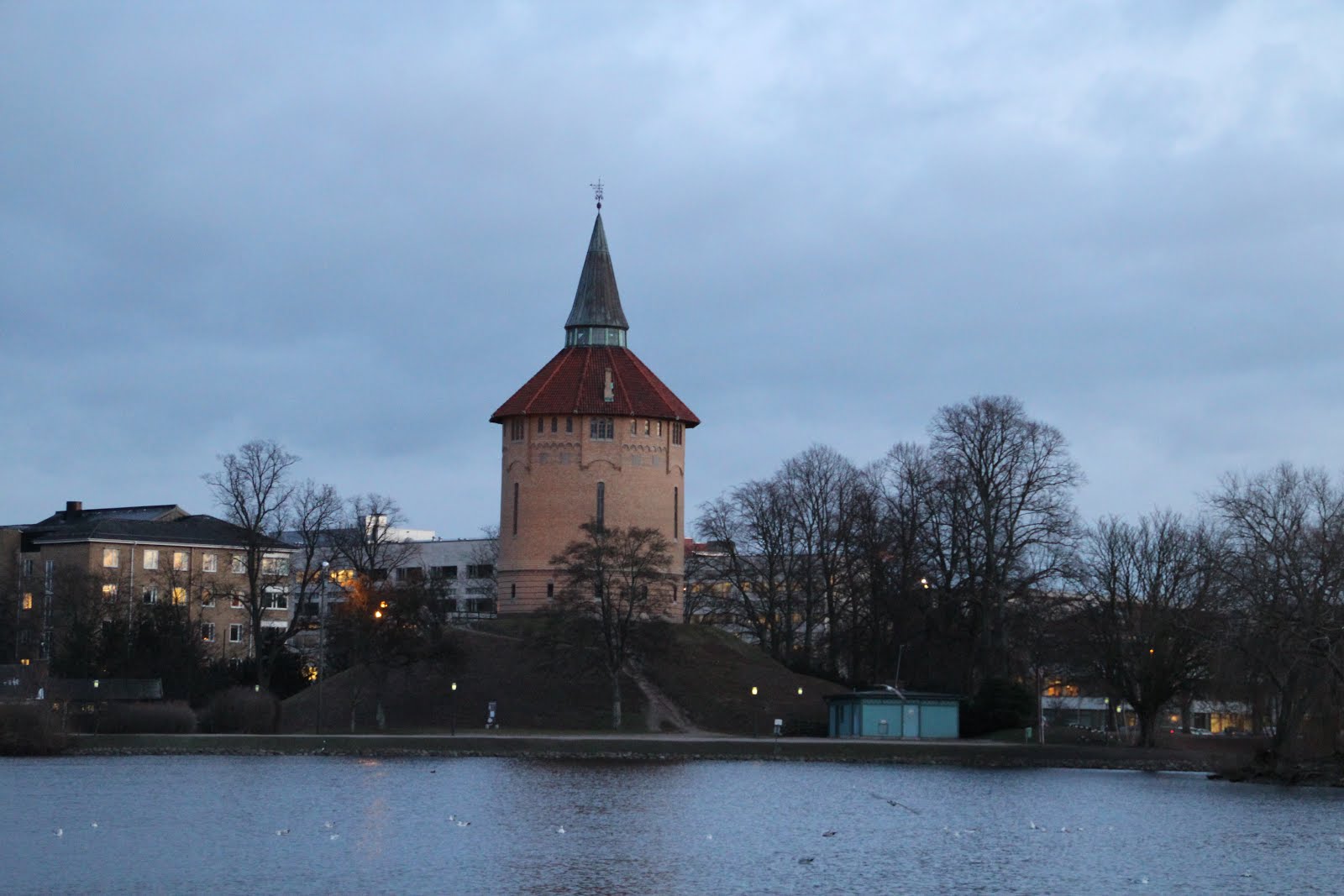
The old water tower in Pildammsparken, Malmö's largest park - we biked there as the sun set.. it was so beautiful!


Malmö Stadsbibliothek, the city library (http://www.malmo.stadsbibliotek.org/), which is basically half a castle and half a giant glass building. Originally built in 1890, the library has more than HALF A MILLION items of different media - not just books, but audiobooks, magazines, music and DVDS - and it was also the first library in Sweden to start lending videogames!! Plus point: they have a great selection of media in ENGLISH, too!


For those who don't know me that well - if you want to know my reaction to a library full of books, imagine Sarah Jessica Parker in a room full of Jimmy Choos. Or a German at a Wurst factory.


Until next time.


Monday, January 28, 2013

On Arriving in Sweden and a Pair of Fluffy Handcuffs

My face is completely scarlet as I stand at the security line at Standstedt Airport, just outside London. The contents of my bag sit on a counter in front of me, and the security card rips open a box that he finds, like a child eager to discover what his Christmas present is. He shakes his head, smiling, and calls out to his colleague;
"Ah, it's jus' a sex toy mate!"
He dumps the pair of fluffy handcuffs on top of the pile of my stuff, and leaves me to deal with the damage, as well as my red face. Ryanair, you could treat your regular clients with a little bit more dignity, please. I'm not a criminal, I just bought a present for a friend of mine which I thought was funny!

At least he didn't find the Sex Pasta ;-)

Arriving in Malmö, the first thing I had to do was buy a ticket for 'the rainbow bus'. No, it has nothing to do with gay pride. It is simply a bus which takes you to the Central Station. As I waited for this luxurious vehicle, I noticed that there stood nearby a tall, slim young woman wearing a mustard coat. I decided to ask her if she knew how long the bus would take. So I did, and we struck up conversation.

We sat together during the trip, and I got to know that she was British, from a town near Cambridge, and that she had come to visit a friend in Copenhagen. I sensed that there was something else behind this, but I decided not to ask. Sometimes it's just not the right time, no matter how curious you are or how many questions you might have.... Not all questions are meant to be answered.

Within minutes of arriving, saying goodbye to my new friend, and walking outside, I was literally attacked by a midget attempting to jump into a photo I was about to take. I gleefully squashed the midget with a giant hug - my dear friend Mina Tolu, as pictured above, and my host over the coming 6 days. I rejoiced to see a familiar face, and excitedly chattering, together we walked around the main streets of Malmö. I was surprised to find that it was snowing, and hoped that I wouldn't freeze.


An hour later, I was convinced that I had made the wrong choice for Erasmus. Malmö is so beautiful with its graceful, elegant architecture, its carefully planned bicycle infrastructure, quaint little cafés selling organic Fairtrade coffee everywhere - I was literally gobsmacked at how different this city looked compared to the one I was living in!

Once we arrived at the student residence, we planned out how we would spend my trip. A student party on Friday, as well as a visit to Copenhagen, were both on the to-do list, as well as seeing some of the main Malmö sights like the 'Turning Torso' and the Pildammsparken old water tower. In the meantime, after a long day (I had slept for only 2 hours on a warm spot near a heater on the floor of Stanstedt airport)I was grateful to have a hot shower and something to eat.

During that time, I got to meet some of Mina's friends; a bunch of Spanish, several Germans, a Polish and a Lithuanian thrown in just for good measure. We all got along from the start...and ended up having some fun together.

This photo illustrates the kind of people Mina likes to hang around with:


Until next time, dear readers :P

Coming up: What to do when you're in Sweden, and daytripping in Copenhagen!

STAY TUNED.

Love,
Tasha

Thursday, January 24, 2013

A Series of Unfortunate Events... First Stop: On Transit to Malmö

I stare with my mouth open, aghast. The sheer magnificence of it all overtook me, and I forgot that it was freezing cold and that I was in want of a hot drink to warm my belly. Standing in front of this palatial building built in a neoclassical style, I imagined the Queen snoring beneth her lavish quilts, a little string of drool daintily connecting her face to her pillow.

Welcome to Buckingham Palace.

On transit to Malmö at Stansted airport, my connecting flight was the following morning. Faced with the prospect of staring blankly at an airport for ten hours, I decided to hop on a coach and explore London - by night.

The fact that it was 10pm and that the city was surrounded by folds of mist did not hinder me. So, I found one of those free maps and boldly (or maybe foolishly) found my way around London. It was relatively easy to navigate, and I walked all around the city with my backpack, taking in the nourishing sights of also Big Ben, Westminister Abbey, the London Eye beside the River Thames, Westminister Abbey, and walked past the Imperial War Rooms. I even made friends with a Russian street artist making caricatures, who wanted to sketch me for free as he said I had the most beautiful of eyes, and besought me to remove my spectacles for a moment.

After 3 hours of walking around, I waited for the coach back to the airport. Lolling against the bus stop, I was suddenly approached by a stick-thin, pale female figure, who began to babble on about being stranded and made homeless and missing a flight. I heard only half her words as I was taken aback by the stare in her eyes; they spoke to me of death. Doubting not her honesty, I offered to her what I could, asking only of her her name and and destination. Jidka, she replied thankfully, a Slovakian heading to her capital, Bratislava.

Still with two hours left to wait at the airport, I found myself a cosy corner of floor to sleep on, not far from some other floor-surfers, who I assumed to be French by their accent. As I dozed off, I thought of Jidka and her wide, staring eyes, and prayed that she would make her flight and safely return home.

Little did I know how soon my small kindness was to be repaid to me...

*story to be continued*


AUTHOR'S NOTE: Once again do I apologize for the much delayed post. Thing is, Life doesn't follow our watch... she speaks in the language of signs, feelings, and coincidences....and the story will unfold to you, one blog post at a time, as though it was written from before... and the reason for my delay will be clear.

See you soon, dear Readers.

Friday, January 18, 2013

All About Aachen...and a German Boot

It's raining as I sit in a train. The weather is trying to show me how German it is, as I haven't seen the sun for two weeks My mother is here. She sits opposite me. I can see her mouth moving, but I tune her out. Thinking that it was a bad idea to take my mother Couchsurfing, I sigh heavily, hoping that the weekend won't end in regrets.

Getting off at the wrong stop, we were lucky enough to have a really sweet host, who picked us up with his car. Looking around his cosy flat, ten minutes from the center of Aachen, I see a guitar in a corner, chocolate in a bowl, an open camera bag with several types of lenses, and I can smell incense. Hmm, I think. This might not be so bad.

Proceeding on what was more or less a night hike around Aachen, my soul was soothed by the sights: the large, well-lit theater with its tall, graceful Ionian columns, the Roman temple style beautifully matched by the Elisenbrunnen, a neoclassical hall which houses one of the city's fountains (see photo). I learned that Aachen had been a famous spa center, known for its natural thermal springs.

The fountain water smelt of rotten eggs, but tasted pretty ok (unlike when I'd done the same thing in Koblenz where the water actually tasted like warm blood!).

We also saw the Puppenbrunnen,or Puppet Fountain, a really cool fountain made with moveable bronze statuettes; we enjoyed a good laugh whilst being immature and moving the hands of the figures into rude postures. On our way to a Mexican restaurant, some locals overheard us speaking in English. One of the men approached us, looked at us seriously. He then proceeded to stretch out his leg, and motioned with his hands towards his foot.

" See", he said, "Zis iss a German boot."

We burst out laughing.

The day after, my mother and I set off, laden with a heavily marked map, and explored the city-center. There were Printen-Bäckerei everywhere, so we obviously realised that they are the typical cookies of the region. We even saw an entire cake made just from the cookies, which was like a metre-high tower!! One of the most memorable things we did was visit the Aachen Cathedral. Officially Northern Europe's oldest cathedral and the first to be registered on the UNESCO list of world heritage in 1978, the Aachen Dom was the church of coronation for 30 German kings and 12 queens. Entering inside, I could see why- all the walls and the entire ceiling were covered in a sparkling mosaic; Jesus and his apostles came alive as the beautiful array of shimmering colours danced in the dimmed light.

It was a joy to stroll at a leisurely pace along the cobbled roads, peeking into the numerous little shops, all with a distinct character of their own. The quaint antique stores with their old-fashioned hat boxes and pocket watches, and heavily perfumed Indie stores selling little wooden Buddhas and crystals, amongst the usual retailer's outlets.

I also took my mother to try the typical food of the region: Currywurst! Though I think she preferred the coffee...We ended the day having dinner at our host's place; some Maltese cheese and galletti. Good wine, some jamming on the guitar, and talking till 2am!

All in all, another great Couchsurfing experience!

Picture below with many thanks, by our lovely host David Wichert


ANNDDD, tune in next time, when I will take you on a trip to..
...sexy SWEDEN!

Monday, January 7, 2013

Home is Where The Heart Is... Christmas in Gelsenkirchen

Hello again, sexy readers. Been awhile since we've seen each other. But not to worry, I have some fantastic tales coming up for you!

A good friend of mine kindly invited me to stay with her and her family for Christmas, and so I was fortunate enough to have the full German Christmas experience. A few things I found out: Germans take Christmas very seriously. Like they do everything else (I kid, I kid). From kilometers of Christmas markets spread around the cities, to mass deforestation of fir trees, to the overconsumption of Spekulatius and mulled wine, Christmas is a big deal here.

Christmas with the Spickermanns

As I waited near a glühwein stand in Buer, I looked out for my friend. I was to meet her family today, to get acquainted with them before I stayed over for Christmas. Suddenly I hear some loud German chattering behind me. It was Lioba and her sister. Shortly we were joined by her parents, her brother, and a tall bearded man with piercing eye and several rings in his ear (her sister's boyfriend). The knots in my stomach slowly undid themselves and they remembered to speak some English every now and then, and as we drank the steaming beverages in the cold, they invited me for dinner, to which I accepted.

On the 23rd I went to watch Lioba sing with her choir. The atmosphere was great, with gospel music and the smell of pine and smoking wood in the air. The day after was of course Christmas eve, so around 2pm I packed my stuff, presents for her and her parents, and a large Maltese dessert called coffee gateux (which we always make for Christmas with my family back in Malta). Later that evening we went to mass, and even though it was in German and I'm not particularly religous, I still enjoyed the ritual. That evening we all had dinner together, with both vegetarian and non-vegetarian fondue and some delicious homemade bread, and I was quite touched by how welcome I felt... I even got some presents!!! :-))) We played some games, and Lioba played the piano and we also sang a German Christmas song together (she taught it to me that afternoon, you can check it out here: http://www.youtube.com/watch?v=OrhIzHLIr1Q) - it reminded me a little of a Christmas scene in a black and white movie!!

That night we didn't sleept much, as we took some wine up to the bedroom and spent 4 hours talking! Seriously, I kid you not. We got like 3 hours of sleep, then spent the day with her extended family - uncles, aunts, cousins, brothers, sisters, grandparents - there were so many people related to each other it reminded me of Malta.

I never ate so much cheese in all my life.

And home-made white chocolate liquor... they gave me a bottle to take home and I'm enjoying the last of it as I am writing now :)

We also enjoyed some more live music:


and some gift-giving... ( BESCHERUNG!!)


...and some MORE food...


and that concludes my best Christmas ever!! <3

NEXT BLOG will be about my second couchsurfing trip, this time to Aachen! And stay tuned, because next week I will be in Sweden ;-)

Happy New Year y'all!!

Sunday, December 16, 2012

A Weekend in Hamburg: A Couchsurfing Experience

When you're in Germany with nothing to do for the weekend and you're pretty much on your own, don't spend it sitting on your Arsch surfing Facebook, looking at photos of people who seem to have lives. Looking at such photos, however, might remind you of the possibility to go out and live your own. You may, however, have to take a few risks... like travelling with strangers. You are probably more sane than me, however, and at least will choose to travel with strangers who speak English.

Anyways, around 2pm on Friday I somehow found myself squashed with four Germans in a car on the way to Hamburg. Trying my best to converse with them, they asked me where Malta is (my dear little rock!) and what I was doing in Germany. I told them that I was studying here on Erasmus and that I decided to go Couchsurfing for the weekend. I was excited to meet my Couchsurfer to see what he was like, and for some inexplicable reason (because you never know who you might meet) in my gut I knew that everything would be fine. So I was not worried at all.

Turned out that my gut was right. A tall man with the most gorgeous green eyes awaited me at the Hauptbahnhof Center. He straightaway acted the role of 'Awesome Tour Guide', taking me round the city center, where a merry and boisterous Weinachtsmarkt (Christmas market) was underway. What fascinated me was the fact that a real-life sleigh - with a real human Santa Claus - rode over the market in the air! We wrestled through the crowd until we found a stall selling hot drinks and drank some Glühwein with rum...mmm, lecker!!

The following morning we woke up, had some breakfast and then got the train to Hafen City, and walked around, starting with the San Nikolai church. We got a lift up to the top of the church and got a panoramic view of the city. Then we walked around Speicherstadt, which is a warehouse district that was used when Hamburg was part of the German 'Zollverein' tariff union, and today a UNESCO world heritage site. The buildings and canals there reminded me a bit of Amsterdam.

We visited the 'Zollmuseum' (customs museum) where I saw how people trasported goods way back, as Hamburg was for years one of the world's greatest ports. My favourite part was seeing how they smuggled stuff through, there was entire display case showing how people trasported drugs across the border, e.g. put cocaine powder in picture frames - and there was a carpet which had 11.2kg of weed woven into it!

We rode a ferry across the Elbe River, and it was so freaking cold but I still wanted to stand on the top of the boat so I could take pictures :) Later, we passed through the Landungsbrücken and went underground to see the Old Elbe tunnel where an old road underneath the river was constructed. Walking in the Hamburg Altstadt, where there was yet another Chistmas market and also a beautifully constructed town hall (as I was taking photos of it, this old German man came up to me and whispered something in my ear...I asked him if he spoke English and he said 'You can take photos of it but you cannot make one like it at home'. he then winked mysteriously and ran away). On the river nearby, there was a gigantic Christmas tree floating in the middle of the water, all lit up, its reflection glittering on the water.

Also in the same day, we packed in the Hamburg Dom, a huge, brightly-coloured funfair rivalling Brighton Pier, and also the infamous 'Reeperbahn', Hamburg's very oen Red Light District. Coming from the super-Catholic Malta (where it was actually debated whether or not to have a condom machine on campus), it was quite unusual for me to see sex shops and brothels on the street next to bakeries and dvd stores. Green Eyes took me to one called 'Bizarre Sex Shop' and its name is an understatement. There was some pretty freaky sh*t in there.
I seriously wondered why anyone would want to be gang raped by aliens, mummies, hitmen, and Santa Claus but I guess this stuff must be on sale because there's a market for it. Creepy.
Although on the bright side, there was an ErotikWeinachtsmarkt nearby, selling dildos with little Christmas hats on them.

My favourite experiences, though, were the gorgeous Japanese Garden 'Planten un Blomen', and the Planetarium; where I lay back on a deckchair-like sofa chair in a dark circular room,watching a 3D-like projection of the Universe on a dome-shaped ceiling with Whoopi Goldberg narrating in my ears. I also enjoyed my first official experience with German family life, with cute little kids making gingerbread houses, having paprika-flavoured Quark for breakfast, and drinking some excellent wine till the early hours of morning. It was there that I discovered the fascinating truth that drinking alcohol helps you to speak a foreign language better. Or maybe because if you have alcohol in one hand, you're already one third more German than you were before.

Truth be said, this weekend I pushed my boundaries with the language and surprised myself; instead of speaking in English with the Erasmus students, I was forced to speak German - and I realised that even when you make mistakes, the Germans appreciate your attempt anyways, and it's practice (not simply memorizing vocabulary!) that makes perfect when it comes to language learning. All in all, the weekend was over too soon, and I reluctantly returned to Gelsenkirchen. Indeed, I felt a little sad that it was over, yet I rejoiced with a little revelation; that sometimes, taking a risk gives you returns in areas you never knew existed.

This is the beauty of travelling.

The world is a book
and those who do not travel
read only one page.

– St. Augustine


____________________________________________________________________
(Dear Readers, next week we will take a break from travelling and blogging
together, however, the week after I'll be back with some exciting Christmas tales to tell you! Wishing you and your families all the best for the season and see y'all in a fortnight. Auf Wiedersehen!
)

References:
- http://www.zoll.de/DE/Der-Zoll/Zollmuseum/Besucherservice/besucherservice_node.html
- http://www.hamburg-tourism.de/sehenswertes/best-of-hamburg/speicherstadt/
- http://en.wikipedia.org/wiki/St._Pauli_Landing_Stages

Sunday, December 9, 2012

Poland, Part 3: On Statues Made From Salt and Food Without Any

A cold wind is blowing, yet my body is warm, haing already walked for over two hours that day. The air is fresh and I am breathing well, my sinuses open and clear. Yet, I am 135m below the Earth's surface. Welcome to the Wieliczka Salt Mines.

Worked on for around 900 years, there is over 200km of passage and over 2,000 caverns in this underground labyrinth. I was unsure about going since its pretty pricey (compared to other museums in Poland, you also have to pay en extra 10zlotys/ 2.50e for a camera permit if you want to take photo) and also its not so clear how to get there, yet it was worth it in the end. There was plenty to see, and the tour guide spoke English well and she had a great sense of humour so we laughed a lot.

With large statues of saints, kings, and philosophers carved into solid salt crystal, complete with a display of coloured lights and Chopin playing int he background, this was a completely new experience for me.
The salt mine is actually so huge that you may also find an entire church underground, complete with a statue of Pope John Paul II which they put there after he visited the place. If anyone is looking for something unique for your wedding, you can also book your ceremony there, they even have several large halls (complete with salt crystal chandeliers) which would easily fit a reception of 200 people.

We saw also several waxworks displays, gigantic underground caverns several storeys high, and stables where they kept horses underground (the guide told us that once they were there, they never saw daylight again until their deaths). The most beautiful thing I experienced was being in a large cavern which, at first, was completely pitch-black. In the darkness, you start to realise a soft sound, that of water falling. Music starts playing, and lights come on slowly, small yellow and purple and green rays, casting beautiful rainbows over a vast salt lake, which glittered and sparkled as the light danced over it...and the lights were programmed with the timing of the music, so when there was a musical climax, the lights themselves burst into joy and the entire cavern was lit up, and we could see the stone ceiling, though it was high up, glittered too, encrusted with crystals and stalacites.

Definitely worth it. Go there if you're in Poland. Nuff said.

There are many more things to do in Poland (particularly Kraków), for example visit the streets of the old town, Sukiennice (a Renaissance icon, see photo)...but unfortunately, you cannot fit in everything! The last thing I would like to write about: the gastronomic Polish experience...

Polish food is a strange, yet delightful phenomenon. Something which fascinated me was the presence of milk bars, which made me think of the film 'A Clockwork Orange'. Known as 'Bar Mleczny', these little curiosities are remnant from when Poland was a Communist state, serving as a way to provide cheap yet nourishing food to the working population.

Typical Polish food includes pierogi, which are are dumplings made from unleavened dough and filled with just about everything - from spinach, to chicken, to apples and ricotta cheese. My dear friend took me (along with the Australian and another friend I made along the way, photojournalist from Mexico) to a typical Polish restaurant with home-made pierogis which had more than 200 different types of pierogi! They were pretty good, especially the spniach ones, and for dessert I tried pancakes stuffed wih ricotta, and served with some kind of vanilla sauce...it was actually kind of disgusting! The pancake was soaked in oil and cheese had a really strange texture, I was glad I only order half a portion! (yes it is possible to do that in Poland).

The best thing I ate in Poland was fried sheep cheese, served with mashed potatoes and colesaw, and cranberry jam... strange, but delicious! And filling :) Interesting drinks I had was this Yerba Mate tea, which gave us a kick when we were in the mountains, and this light brown beverage served in a glass bottle called Kvass, which translates as 'bread acid', made from fermented bread. The best thing I drank however, and this should interest my German audience, was.. HOT BEER. (it's like Glühwein but they use beer instead of wine!). Basically you get a typical lager beer, add a little sweetened ginger syrup, spices like cinnmon, cloves, and orange rind, and heat it up - you are instantly warmed up even just by the smell! Oh man it was soooo tasty!!


Anyways, dear readers - I hope you all enjoyed Poland :) Tune in next week - where you'll hear about floating Christmas trees, an opera house made from glass, and a street full of sex shops rivalling the Red Light District,

my first official Couchsurfing experience in Hamburg, coming to a blog near you.

Bis dann ;-)


(Blog dedicated with special thanks to my dear friends Justyna and Łukasz, who hosted me during my stay in Poland and made all this possible - missing you both very much!)

Monday, December 3, 2012

Poland, Part 2: From Castles to Concentration Camps

On the Wawel Castle and its Dragon, Kraków

On Sunday I woke up with my muscles aching from the day before, yet I felt great. Excited to wake up to greet the day, a breakfast of freshly made pancakes and stewed apples waited for me. Then, Justyna and I wrapped up warm and set off to the centre of Kraków to explore.

Walking along the Vistula River (which is the longest river in Poland) we enjoyed watching people strolling along its banks, seagulls screaming and diving into the water. A gigantic hot air ballon rose above the buildings, half-hiding in between the folds of a light fog, bathing everything in a mysterious, pastel pink-yellow glow. We made a brief stop at the Manggha Center of Japanese Art and Technology ( http://manggha.pl/ )- a large, low building shaped like a wave and produced by the famous Polish film director Andrzej Wajda in 1995.


The Wawel dragon is a well-known character in Polish folklore as he ate up all the young maidens of the region. He lived in a cave underneath the Wawel Castle, and one day King Krakus promised his daughter´s hand in marriage to whomever slayed the dragon. One day, a cobbler´s appretice stuffed a lamb with sulphur and gave it to the dragon, who became so thirsty that he gulped down half the Vistula river, and then rolled over and died. So, it was a happy ending, as the cobbler´s apprentice married the princess, and the dragon´s cave is now a shop for tourists.

Above, Wawel castle stands, still and quite overlooking the river, with picturesque green ivy climbing up its scarlet bricks. Legend has it that on December 24th, all the deceased kings of Poland gather here to celebrate in an underground chamber. A strange architectural jumble with a variety of styles competeing for attention, the styles include a mix of Renaissance and Gothic (which is like the Koeln cathédral meeting St. John´s ´co-cathedral in Valletta - can you imagine?) but somehow, it works, carrying off a unique sense of peculair beauty. The chapel was surely one I was particularly thrown off by, I had never seen the likes of it before. With marble sculptures bearing the graceful, decorative, curvaceous lines characteristic of the Baroque era, yet housed in the tall, solemn, pointed arched of the Gothic style, combined with painted wood, gold leaf, and plaster crown mouldings, this was an artistic treat for anyone with a cultured eye.


Day 3... "Arbeit Macht Frei"

That morning, I hopped on a train to Oświęcim (Oz-vee-chiym). A small, typically unimpressive Polish town. Several old, ugly, and hopefully derelict buildings dot every corner, and people are walking about the market. Doing their shopping on a Monday like any other. Yet, this small town comes with a big story; it was once the home of the largest of all the concentration camps belonging to Germany.

The camp is split into two parts which you can visit. Following a friend I made on the train (a light-hearted, chatty Australian filmmaker), I first went to Auschwitz I, which consisted of the original camp (and is now the main museum), and then Birkenau (Auschwitz II) which was the extermination camp, opened later in order to ease congestion at the main camp.

I spent all day there, yet still, I cannot describe to you fully the profound effect this place had on me. It was not just the knowledge that, over a million people were murdered there, oh, no. What really got to me was the fact that... the buildings were pretty... orderly, cute red-brick structures, a lush green lawn, people hanging around talking, laughing, taking photos, buying postcards*.... who would ever believe, who would ever imagine - had it not been written on plaques everywhere - that such atrocities were committed there? That less than a hundred years ago, all kinds of actual human beings, real men, women, and children, lived and breathed and squirmed and died there, the ground, this lush green grass that you walk upon, is probably still drinking their blood!

I pictured men lining up, the scarlet walls spattered with shards of skull and bits of brain as the bullets entered their heads, how the women watching from behind the bars must have screamed, like their souls were being ripped out from their bodies, I imagined children starving slowly to their deaths, their skin sticking to their bones, to the insides of their cheeks as though they were trying to imitate a fish sucking in water. But no games of pretend for these children, Hell was their reality. Where the morning greeted you with not warm blankets and mummy´s kisses, but with the saltiness of tears and the warmth of flowing blood.
(*Yes, buying postcards. You can now send your mother a picture saying 'Ich war hier!' with the wrought-iron words "ARBEIT MACHT FREI" in the background.)

I walked into one large room whose walls were covered with photos, side by side, frontal portraits. The room was filled with wire structures in the shape of human beings walking after each other, backs bent. The haunting structures were clothed with prisoner´s uniforms, and the headlessness gave the eerie impression that ghosts were present. I watched the other tourists casually strut about, nonchalantly, popping gum bubbles noisily, and wondered if they knew that the eyes of ghosts were watching them.

Another large room, a very long, rectangular one this time. An attendant forbids me to take photos in this area. The room is dark, dim, and the little light which is present has a strange colour because there is some kind of purple filter on the glass of the windows. One third of the room is taken up by a gigantic display case, with angled yellow light cast on what seems to be piles upon piles of woolly intestines, mostly a dusty colour, a mix of brown and grey, with the occasiocal light streak of whitish-yellow. Completely mystified, I ask my friend what this thing is. He looks at me and shakes his head.

"It's human hair", he says. "Used by the Germans as raw material for the textiles industry... you know, to stuff pillows, make ropes with. About two tonnes of it."

I feel extremely naseous. Even more so, when on the other end of the room, a much smaller case displays a collection of long braids, different colours, blonde and auburn and chestnut brown, cut off from the heads of young girls.

I leave the room... walk away from the building...past the people...run to the toilets....

Sitting with the door closed, and I can do nothing but cry.


REFERENCES:

http://en.wikipedia.org/wiki/Auschwitz_concentration_camp#cite_ref-rees2_15-0
http://en.auschwitz.org/m/
http://myths.e2bn.org/mythsandlegends/userstory6306-the-legend-of-the-wawel-dragon-a-polish-traditional-legend.html

Sunday, November 25, 2012

Adventures in Poland, Part 1

I am sitting on the floor. My back presses against a door to keep it open, whilst my knees I struggle to keep to my chest so that people can try to get to the bathroom. I am wedged in between a sleeping teenager, a girl my age attempting to read, and a rotund drunken man who has begun to sing a song in what I assume to be Polish.
The journey lasts three hours.

By the time I arrived in Krakow on Friday, it was already dark at 5.30pm. After a full 13 hours of travelling, finally I had arrived, and boy, was I exhausted! So, I felt exhilarated to see once again the bright face of my dear friend Justyna, buried underneath several layers of clothing and a thick beanie, waiting for me with a big smile warmer than her outfit. In the meantime, a thick fog had spread over the city, smothering anything that was more than a few metres away. As a result, I didn't really see much of Krakow until Sunday, as Justyna had something special planned for Saturday. That night, we ordered a 'spinaci' pizza (minus the spinaci) and I told her about my adventures on the train. Which included being proposed to by the drunken guy and making friends with the girl (and being invited for a smoke with her and two random guys in the bathroom). Exciting, indeed!

Day 1: The Trip to the Tatras

Wake up at 7am. It's dark. Shake off the grogginess, shower, put on three layers of everything except underwear. Laugh at yourself in the mirror.
Drive two hours in the fog. Watch the early morning sunlight being filtered through it as you cup an energy drink in your hands as though it were warm.
Arrive. Park. Watch people load baggage onto carriages pulled by two horses. Your breath comes out in steam. You feel sorry as your friend comments that several horses have died from the trip. You feel even sorrier when she says you're about to spend around 8 hours hiking (and the last time you excercised was around two weeks ago).

Walking slowly uphill, you're already about to die after twenty minutes. The cold presses on your head, and your backpack is heavy and drags you backwards. You know that in 40 minutes you will leave the easygoing tarmac road, and it will be rocks, mud, and frost all the way uphill for three hours after that. You think 'There's no way I can do this. I can't. I won't.'

You stop. You breathe in, long and heavy. Something catches your eye. Clusters of long, thin, slightly curved ice tubes, a silvery-white colour. They look like strands of fibre optic. As we approach the bare soil, we notice not one, or two, but hundreds of these shimmering bundles everywhere. Fascinated, I ask my friends what these curiosities are. She replies; "I don't know, I've never seen them before."

We continue to hike. My initial frustration has left me, and we trudge rhythmically forwards and upwards, through forests, past waterfalls, over frosted boulders reflecting the pastel yellow sun. I notice that the ice tube clusters seem to have gathered only where the soil is exposed. I briefly recall a Geography lesson from years back.
And then it hits me.
"It's transpiration!!", I exclaim.
"Huh?" Justyna raises an eyebrow.
"You know when you have evaporation? This is water vapour from plants, or in this case, the ground, going up to the sky and being frozen on the way."
And, as though to prove my point, we come across a large patch of bare soil, not only with these little tubes, but actually icicles emerging from the ground, pointing like spears to the sky. Happiness wells up in my chest, gives me strength to continue.

As we climb higher and higher, I stop to gaze, gobsmacked. Imagine a panoramic view of berserkly rockied mountaintops, with snow falling down the sides. As we try not to slip, walking uphill over a frozen stream, a steep side of the mountain comes into sight. It is glinting in the light, and when we approach, we stop in our tracks as we the reason see why.

A glittering waterfall of ice stands magnificently before us. Large falling bodies of water, frozen in space and time, drop steeply to the ground. You can see every wave, each ripple- carved into the waterfall's surface, still and shining, caught in a flow over the sides of the mountain. Like the folds of a woman's dress flow over the curves of her body, so the river drapes the mountain.

Wonder upon wonder is thrust upon us, everywhere we turn, we see magnificence and beauty. And when we finally reach our destination, a tiny hostel nearby a frozen lake which is dwarfed by the sheer size of the surrounding mountainrange; we felt not tired, but re-energized, reborn, filled once again with that initial wonder and fascination, with not only nature, but life itself- that wonder which we somehow lose in the process of our mind's petty rountine: work, stress, worries - and in the process of losing this wonder, we forget how to live, what it means to be truly alive.

If there ever was a time in my life where things were so dark that I wished I were dead... well, this day made me grateful that that wish never came true.


END OF PART 1

Blogger's Note:
The trip will be divided into three parts in an attempt to do justice to the experiences that I attempt to describe. Also, since my funds are running a bit low, will not be sure if I travel anywhere else until mid-December. But, more on that later...

Also, what would you, dear Readers, like to hear about? Tips on travelling with a student budget, good places to eat/visit? Have any of you ever been to Poland, and what was your experience?

Comments below :)

Tuesday, November 13, 2012

"Yeah, it's a shithole. But we love our shithole."

Welcome to my home city: Gelsenkirchen.

The caption to today´s article is a quote from one of my colleagues who is from this very special city. You might get an idea why he said this later on.

Anyways, you probably haven't heard of Gelsenkirchen before. That's probably because it is one of Germany´s smaller cities. GE forms part of the North-Rhine Westphalia, hosting around 267,000 people. Previously it had a large coal-mining industry, and for this it was known as “the city of a thousand fires” due to the flames of the mine gases during the night. Something interesting to note is that during World War II, it formed part of the Buchenwald concentration camp for women.

One of Gelsenkirchen´s biggest attractions is the Veltins Arena, a huge football stadium which hosts the local football team of Schalke 04. This means that it is quite common during all times of the day to see drunken people smelling of bratwurst and walking about wearing blue and white singing in chorus (including on the trams). You might also bump into several men who are, most openly and proudly, taking a piss in full view during your leisurely stroll in the park.

(the photo below right I took today, waiting for the tram. It shows the main street of Buer, where there are many shops, cafes, etc)


Other interesting things to see/do here in GE include visiting theme park of ´Movie Park Germany´ (which is fantastic fun, yet on the more expensive side. During Halloween the park stays open until 10pm, and they hire people to wear sick-looking, yet highly realistic makeup, and to run around wild with buzzing chainsaws and give the visitors the fright of their life - see photo), the zoo of ZOOM Erlebniswelt (which I have still to visit, maybe when my budget allows), and also, the Kunstmuseum in Buer, which has a really cool section of ´Kinetic Art´where you can touch the works and interact with them, like clap your hands and they do something like make funny sounds or create light effects (It´s also free of charge). Check it out: http://stadt.gelsenkirchen.de/de/Kultur/Kunstmuseum/

Gelsenkirchen today hosts Germany´s largest solar power plant, and simultaneously, Germany´s tallest chimneys. Several times a week I hear alarms going off, either the ambulance, the police, someone´s car, or the fire brigade. And, since I´ve been living here, I´ve seen the damaged windows of attempted burglaries at least twice. In the same street.

Along with a high rate of unemployment and the fact that half of the city seems to be under construction, one would think that it is not exactly the ideal place to live. So I refer to the above quote. Nevertheless, the city sticks to me like the smell of raw garlic, and admittedly I a fondness has taken root in my heart for this place.

I love how, whilst I´m waiting for the tram in Buer after a long day, the light of the setting sun bathes everything in a soft golden light, and the metal cut-out of a man standing holding an umbrella on the opposite building looks a little warmer. I enjoy shopping for groceries at Netto or the SuperBiomarkt, where everything is still in German - but now, most things I can understand, and the young man at the cashier smiles at me, because now I am a familiar customer to him.

It´s exhilarating too, whenever I feel heavy or down, or simply like I have too much on my mind, to be able to walk for several minutes and then to be in a park, surrounded by foliage and tall, dark tree trunks. I enjoy treading along the path which is lost under the reddish-orange leaves (that have long fallen off the trees), they crackle like a fire burning under my footsteps.
If you, too, walked along this path, you would eventually arrive near a wide green lake, complete with ducks and swams swimming on its surface. And on this lake, you too could watch the coloured lights dance, as the sun sets in its reflection.


Short note:
Next week´s blog will be late.
Because.... I will be in POLAND.....
;-)

Sunday, November 4, 2012

A Diversion from Travelling: On Germany and the Germans

Hello once again, dear Readers! For this blog entry we will be taking an inside look at what it is like to actually live in Germany. Are the Germans really like the stereotype? Are they tall, cold and reserved, do they really feed only on copious amounts of beer and sausage, and simply drink water to surprise their liver? Can they only speak English with an enthusiastic 'Ja!' every three words? Read on.

So, I've been living in Germany for the past two months, and I think I've gotten at least a basic impression of the strange, yet alluring people known as 'Germans'. And the one thing that really hits me is that no two Germans are alike. Especially if they come from two different regions. For those who aren't German and reading this, Germany is made up of sixteen states, known as Bundesland. These states are actually more like little countries, so German sounds significantly different if its spoken by someone from Hannover, as compared to someone from the Bavarian region. The Hannover German is considered to be the 'high' or 'proper' German, whilst the Bavarian German - isn't really considered German.

This makes the language a little more difficult to learn. Apart from adding in lots of grammatical rules, with plenty of exceptions, it also has which have three genders. The Germans just like to add in extra rules, for fun. And we non-natives are left speechless (pun intended) even whilst attempting to form the simplest of sentences. As illustrated below.


Yes. German has its own style of doing things. It likes to be different, to stand out, to prance about in lederhosen whilst everyone else is still wearing skinny jeans.

On the other hand, German is remarkably creative. It has a way of wording things that allows for a greater capacity for expressing oneself, for greater understanding. Which I love. One of my favourite words is 'waldeinsamkeit', which has no translation in English. It refers to the feeling of being alone in the woods. Google Translate calls it 'forest solitude'. Which doesn't really quite sum it up. So at least, the 101 rules that come along with learning the language serve some kind of purpose.

Apart from their language, the Germans generally have laws for everything. You can't find or download original films or music online (unless you want to pay a hefty fine), it is illegal to tune pianos at midnight, and a pillow is actually classified as a 'passive weapon' and hitting someone with one can lead to charges of assault. There is even a law determining where you can walk, when you can walk. Like if you want to cross the road, and the little stick man on the pedestrians' traffic light is red, woe betide you if you cross the road. You may get a fine if a policeman sees you; otherwise you simply receive a few withering looks and comments about your mental state of mind. This goes for all times of the day; it is not uncommon to see people at 2am on the sidewalk of an empty road, waiting for the little stick man to turn green.

Apart from being adept at making the most finicky of laws, Germans tend to have other talents, such as having great taste in clothing. Both men and women tend to dress well, choosing colours and cuts to suit their own style. Although to be fair, that's significantly easier when you're tall and blonde.

Germans are also gifted in the time-management section. It is very rare that I meet a German who wastes time. Yes, they use Facebook and spend time socializing like everyone else, but almost everyone in their spare time either plays an instrument, does sports (usually badminton or table tennis), reads a good book– fixing cars or motorbikes seems to be somewhat of a favourite pastime amongst men. One of my German friends spends his leisure time making money by surfing Ebay for old crap, fixing it up a little, and reselling it.

No wonder the German economy is so strong.

Other things to note about Germans and Germany: the love of Wurst is not exaggerated in the stereotype. Germans really love their sausage. They even have butcheries dedicated solely to sausage; and in Berlin, the well-loved Currywurst (a fried pork sausage drowned with warm ketchup and liberally sprinkled with curry powder) even has its own museum ( see http://www.currywurstmuseum.de). On the other hand, they also have a thriving vegetarian community, and all restaurants have a vegetarian section on the menu with plenty of appealing options to choose from. However, be warned – 'Vegetarian' in German ususally means 'drowned in cheese'.

Apart from the stereotype about German love for sausage, German love for beer is also not exaggerated. Here one can find many ways to drink beer – such as mixed with cola or fanta or even as a marinade for your sausage. There are over 200 types of German beer, including chili-flavoured beer, banana-flavoured beer, and even chocolate -flavoured beer, and boy, can they drink!
Germans seem to be generally suspicious of beverages that don't sparkle and you will generally have trouble finding still bottled water to buy. Which is odd since Germans also seem to be suspicious of drinking tap water.

Germans also seem to love foreign food (or rather the eingedeutscht version) and anywhere you go in Germany you will notice an abundance of thriving restaurants, particularly Kebap Häuser, where a typical dish is a doner kebab with a generous side of sauerkraut. The Germans have also borrowed the Italian concept of gelateria and turned it into what is known as an Eis-Cafe, where any kind of dessert with ice cream may be found, from waffles to strudel, to simply ice-cream cream on its own (also available in spaghetti form and known as Spaghetti Eis).

There is really so much to say about die Deutschen that I really could write an entire book about them and their culture! Actually,there is one: 'The Xenophobe's Guide to the Germans' (I borrowed it off my professor). They worship football, cars, David Hasselhof, and recycling; they don't know how to queue; and they hold a special place in their hearts for herbal remedies. And dogs; in fact, their dogs go with them everywhere, on buses, trams, and some Germans even have little buggies to attach to their bikes so that their dogs can come for the ride.

Anyways, that concludes this blog on the Germans, next week: A focus on the one city I haven't written about yet: my hometown!

An insider look at the special city of.... Gelsenkirchen.

Auf wiedersehen, meine Lesen!

(extra note: the above blog is dedicated to my avid reader, Katja Drope :D hope you like it, Kat!!)


References:

http://www.telegraph.co.uk/news/worldnews/europe/germany/4399866/Ten-crazy-German-rules.html

http://nasenbohrer.com/


Followers